

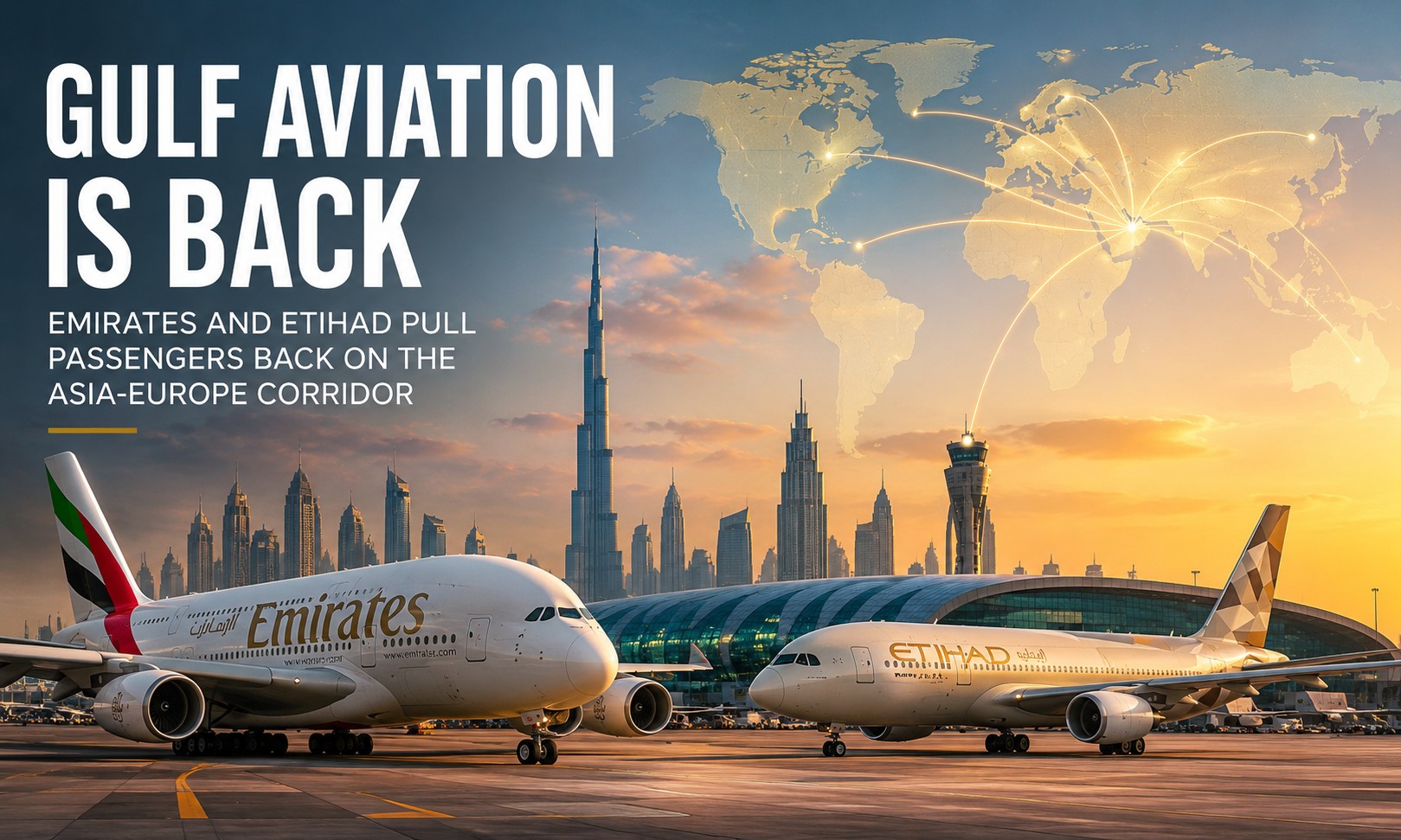
Something is shifting in Gulf aviation. And it is not subtle. Emirates and Etihad Airways are pulling passengers back from Asian carriers on the Asia-Europe corridor, and the numbers tell a story that airport lounges have already been whispering about for weeks.
By mid-June, Gulf airlines had rebuilt roughly 90% of their flight schedules. That is not a modest recovery. That is a full-throttle return to form.
Dubai and Abu Dhabi are once again functioning the way they always have: as the connective tissue between East and West. Millions of travellers are gearing up for the summer rush, and more of them are choosing to route through the UAE than they were just months ago.
Why? Ask any travel agent in Dubai and you’ll hear the same answer.
Confidence is Back:
Booking confidence, that is — the quiet metric nobody puts on a billboard but every airline lives or dies by. Customers who drifted toward Asian carriers during the disruption are drifting back. Not because of price alone. Because of dependability.
Read More: UAE Public Holidays 2027: When is Next Long Weekend?
What’s Actually Pulling Passengers Back:
Here’s the kicker: cheap fares aren’t the whole story anymore. Passengers heading to Europe are weighing something bigger than a ticket price. They want:
- Flights that leave when they say they’ll leave
- Layovers that don’t eat half a day
- Baggage allowances that don’t punish a family vacation
- Service that feels like an experience, not a transaction
Emirates and Etihad happen to check every one of those boxes. And that combination — reliability plus comfort plus reach — is proving hard for competitors to match right now.
The Network Keeps Growing
Emirates alone runs one of the largest international route networks on the planet. That’s not new. What is new is the pace at which Etihad is expanding into Africa while tightening its Gulf-Asia-Europe web.
Add flydubai and Air Arabia into the mix, and UAE carriers collectively now reach more than 420 destinations. Direct flights. Connecting flights. All of it.
Rewind to earlier this year and that number looked shakier. Operational disruptions had thinned out route availability across the board. Airlines had to rebuild, not just restart.
They rebuilt fast. Europe, Asia, Africa, North America, Australia — the map filled back in region by region.
Why Dubai & Abu Dhabi Matter:
Every recovery story in aviation eventually becomes a hub story.
Dubai International, Zayed International in Abu Dhabi, Sharjah Airport — all three are bracing for a serious jump in passenger traffic as summer peaks. More flights means more connectivity, and more connectivity means better outcomes for both business travellers chasing meetings and leisure travellers chasing beaches.
Trade benefits too. It always does when hubs get busier.
Read More: How to Get a 20-Year Emirates Skywards Platinum Membership | Step by Step Guide
Reliability, Not Just Recovery:
Is this just a temporary bounce, or something more durable?
The signs point toward durable. Passenger behavior has shifted toward valuing consistency over rock-bottom fares, and that’s exactly the lane Emirates and Etihad have built their reputations in for decades.
As frequencies keep climbing and networks keep widening, travellers should expect more choice, more flexibility, and smoother connections across half the globe.
Gulf aviation isn’t just recovering. It’s reasserting itself as the connective backbone of long-haul travel — and the UAE’s role as a global gateway looks steadier than it has in a long while.
