

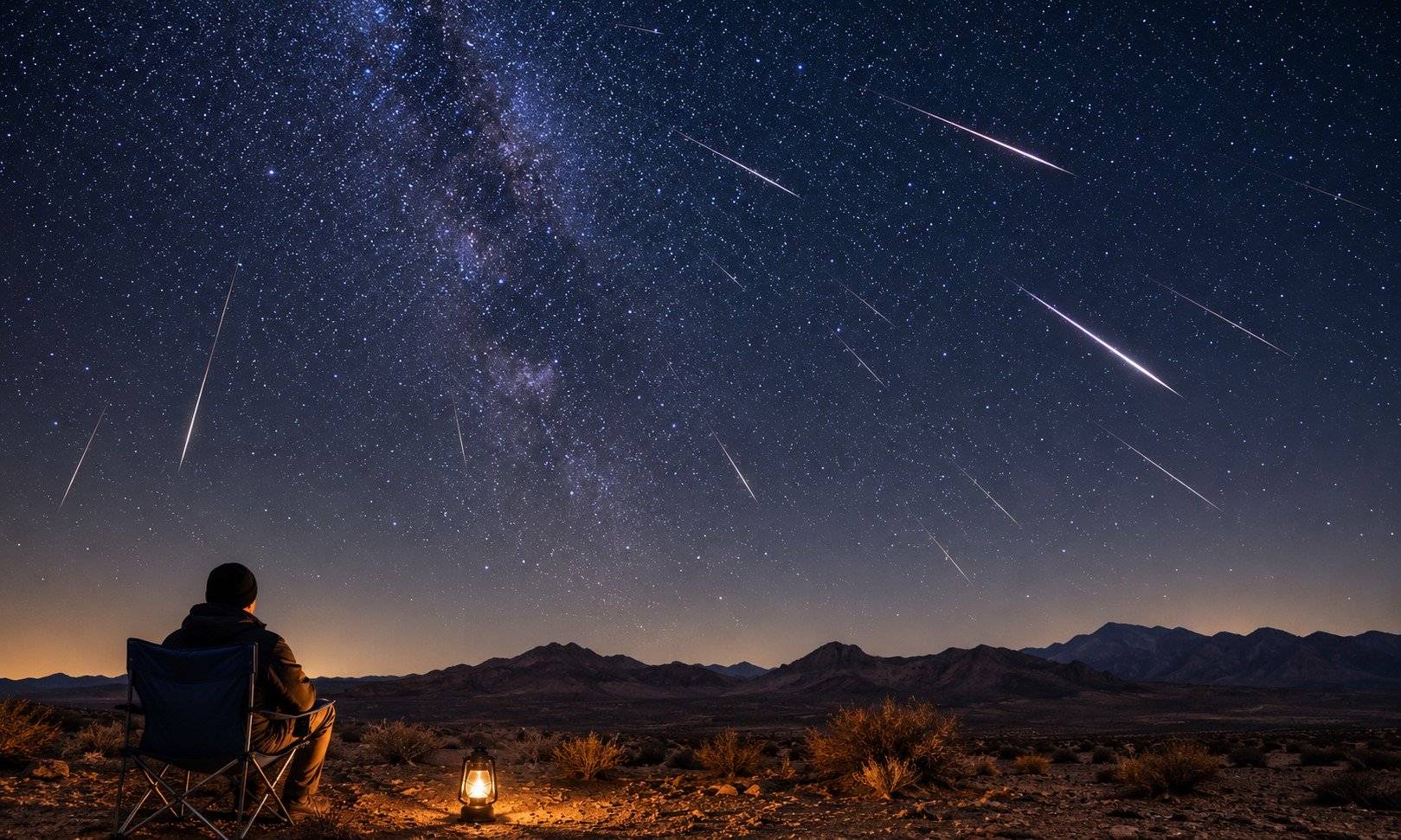
Ready for a night under the stars? One of the year’s most anticipated meteor showers is about to reach its peak, and skywatchers across the UAE have a particularly good reason to look up this August.
The Perseid meteor shower will reach its peak on the night of August 12–13, 2026, with the shower arriving under a New Moon. That means there will be very little moonlight competing with the meteors, creating excellent conditions for dark-sky viewing if the weather and visibility cooperate.
The Perseids aren’t the only meteor shower active during the UAE summer. The Southern Delta Aquariids reached their peak at the end of July, while the Perseids remain active through August.
Here’s everything you need to know before planning your meteor-watching night in the UAE.
When Can You See the Perseid Meteor Shower in the UAE?
The Perseids are active from July 17 to August 24, with the main peak expected on the night of August 12–13.
For the best chance of spotting meteors, plan to stay outside after midnight and into the pre-dawn hours, when the shower’s radiant is higher in the sky and more meteors become visible.
The exact number you’ll see will depend on your location, light pollution, weather and how dark the sky is.
Read More: Best Places to Celebrate New Year’s Eve in Dubai: Fireworks, Parties & Family Events
Perseid 2026 at a Glance
Peak: August 12–13, 2026
Best time: After midnight to before dawn
Active period: July 17–August 24
Parent comet: 109P/Swift-Tuttle
Best conditions: Clear skies with minimal light pollution
Why Are the 2026 Perseids Special?
This year’s Perseids have an important advantage: the peak coincides with a New Moon.
A bright Moon can wash out fainter meteors, making them difficult to see from the ground. In 2026, however, the Moon will not be providing significant interference during the Perseid peak, creating particularly favourable dark-sky conditions.
The Perseids are also known for producing fast, bright meteors. They are created when Earth passes through debris left behind by Comet 109P/Swift-Tuttle. As tiny particles enter Earth’s atmosphere at around 59 kilometres per second, they heat up and produce the bright streaks we see across the night sky.
How Many Meteors Could You See?
You may have seen the Perseids described as producing up to 100 meteors per hour.
That figure refers to the shower’s theoretical zenithal hourly rate (ZHR) under ideal conditions — essentially a best-case scenario for a perfectly dark sky with the radiant directly overhead.
For 2026, the International Meteor Organization expects a lower ZHR of roughly 30–50 meteors per hour, as Earth is predicted to pass through a relatively sparse section of the Perseid debris stream.
In a real UAE viewing location, the number you actually see can be considerably lower. Light pollution, haze, humidity and the position of the radiant all affect visibility.
Still, even spotting a handful of bright meteors can make the experience worthwhile.
What About the Southern Delta Aquariids?
The Southern Delta Aquariids are another major summer meteor shower visible from the UAE.
Their 2026 activity period runs from July into August, with the peak occurring around July 30–31. However, this year’s peak was heavily affected by a nearly full Moon, making the fainter meteors much harder to see.
The shower is known for producing relatively faint meteors and is generally better observed from more southerly locations. For UAE skywatchers, the Perseids therefore offer the more exciting viewing opportunity this August.
Where Can You Watch the Meteor Shower in the UAE?
The biggest advantage you can give yourself is getting away from artificial lights.
Dubai’s bright skyline can make it difficult to see fainter meteors, so heading towards darker areas outside the city is recommended.
Popular UAE stargazing destinations include:
Al Quaa Desert, Abu Dhabi
One of the UAE’s best-known dark-sky locations, Al Quaa is far away from much of the city’s light pollution.
Liwa Desert
The vast desert landscape around Liwa provides wide, unobstructed views of the night sky and plenty of space to set up a comfortable viewing spot.
Jebel Jais, Ras Al Khaimah
The higher elevation and mountain surroundings make Jebel Jais a popular destination for stargazing, although visibility can still depend on weather and atmospheric conditions.
Al Qudra Desert, Dubai
For Dubai residents who don’t want to travel too far, Al Qudra offers a relatively accessible option for escaping the city’s brightest areas.
Always check access conditions and local rules before heading into remote areas at night.
UAE Meteor Shower Viewing Events
If you’d rather not plan the experience yourself, organised astronomy events can make meteor watching easier.
The Dubai Astronomy Group has hosted guided astronomical experiences at locations including Jebel Jais, where participants can observe meteor activity with the help of astronomy experts and professional telescopes.
Another option is an organised desert experience, such as those held in Al Quaa, where visitors can combine stargazing with dinner and traditional desert activities.
Event schedules and availability can change, so check directly with organisers before travelling.
Do You Need a Telescope to See the Perseids?
No! In fact, you may be better off leaving the telescope at home.
Meteor showers can appear across a large section of the sky, so watching with the naked eye gives you a much wider field of view.
A reclining chair, blanket or comfortable camping setup can be more useful than expensive equipment.
If you want to identify constellations or understand what you’re seeing, astronomy apps such as Stellarium can make the experience more interactive.
Tips for Watching the Perseids in the UAE
1. Get Away From City Lights
The darker the sky, the better your chances of seeing faint meteors.
2. Watch After Midnight
The best viewing generally comes after midnight and into the pre-dawn hours.
3. Give Your Eyes Time to Adjust
Allow around 20–30 minutes for your eyes to adapt to darkness.
Avoid looking at your phone repeatedly, as bright screens can interfere with your night vision.
4. Look at the Whole Sky
Don’t stare at one particular point. Meteors can appear across the sky, even though they seem to originate from the direction of the Perseid radiant.
5. Check the Weather
A perfect meteor shower is useless if clouds, haze or humidity block the sky.
Check the local forecast before setting off.
6. Bring Water
August nights in the UAE can still be warm, particularly in desert locations. Take plenty of water and plan your trip with the heat in mind.
7. Choose a Safe Location
If you’re heading into the desert or mountains, make sure you’re visiting an accessible and permitted location and have enough fuel, water and phone battery for the journey.
What Is a Meteor?
Despite being commonly called shooting stars, meteors have nothing to do with stars.
A meteor is the bright streak produced when a small piece of space debris enters Earth’s atmosphere at high speed and heats up.
If the object completely burns up in the atmosphere, the visible streak is a meteor.
If part of the object survives the journey and reaches the ground, it is called a meteorite.
Frequently Asked Questions
When is the Perseid meteor shower in 2026?
The Perseids are active from July 17 to August 24, with the peak expected on August 12–13.
What is the best time to watch the Perseids in the UAE?
The best opportunity is generally after midnight and before dawn, particularly around the August 12–13 peak.
Can I see the Perseids from Dubai?
Yes, but light pollution can significantly reduce the number of meteors you see. Travelling to a darker location outside the city will improve your chances.
Do I need a telescope?
No. The Perseids are best enjoyed with the naked eye because meteors can appear across a wide area of the sky.
How many meteors will I see?
The International Meteor Organization expects a ZHR of around 30–50 meteors per hour in 2026, although the actual number visible from the UAE will depend on conditions and your location.
Is the Southern Delta Aquariids meteor shower still visible?
The Southern Delta Aquariids remain active into August, but their 2026 peak occurred around July 30–31 and was strongly affected by bright moonlight.
Read More: Top 13 Best Indian Restaurants in Abu Dhabi for Authentic Indian Food
Final Thoughts
The UAE’s summer skies have plenty to offer, but the 2026 Perseids are the event to put on your calendar.
With the shower peaking on August 12–13 and a New Moon providing exceptionally dark conditions, this year’s display offers skywatchers a particularly good opportunity to spot meteors away from the city’s bright lights.
So find a dark location, switch off your phone, settle in and give your eyes time to adjust. You don’t need expensive equipment or an elaborate setup — just clear skies, patience and a good view of the stars.
And if you’re planning your own UAE stargazing adventure, August 12–13 is the night worth keeping free.
