

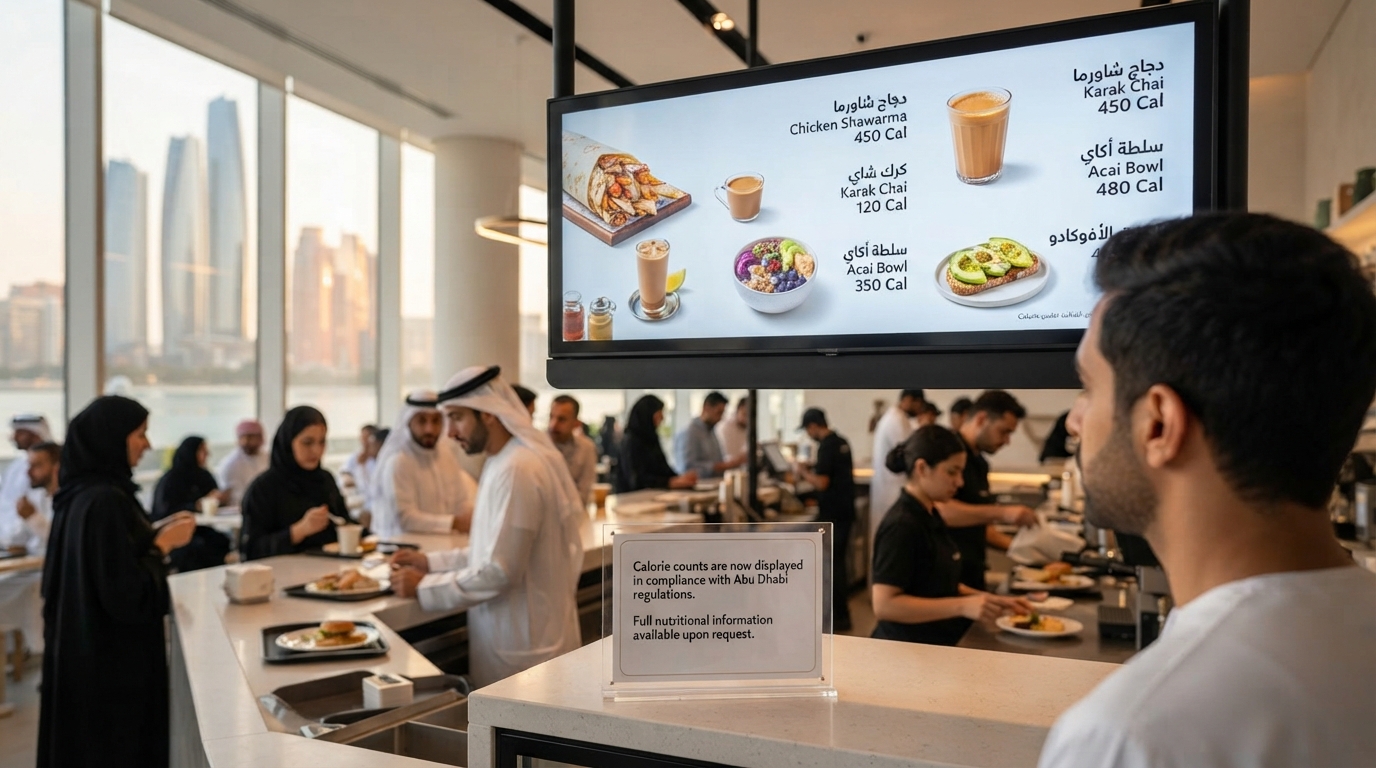
Quick answer: From 1 June 2027, every restaurant, café, food truck and entertainment venue in Abu Dhabi must show the calories of each food and drink item on its menus, including online menus, self-order screens and drive-through boards. Businesses have a six-month grace period to prepare, and more detailed nutrition information must be given if a customer asks.
Next time you order a karak and a chicken shawarma in Abu Dhabi, the number of calories could be printed right next to the price. The capital has announced that calorie counts will soon be compulsory on every menu, and the rule reaches further than many people expect.
Here is what the new Abu Dhabi calorie labelling rule covers, who is exempt, how restaurants will work out the numbers, and how it could change the way you order.

What the Abu Dhabi calorie labelling rule says
The policy comes from Healthy Living, Abu Dhabi’s government-led wellbeing programme, working with the Abu Dhabi Registration Authority. Under the new rules, outlets must show the calorie content of every item in kilocalories (kcal). If you ask for more, such as protein, fat or carbohydrate values, the outlet has to provide it, as reported by The National.
Where you will see calorie counts
This is not just about printed menus. Calorie information must appear on:
- Physical menus in restaurants and cafés
- Online menus
- Promotional materials
- Self-order kiosks
- Drive-through display boards
The rule applies to restaurants and cafés of every size, including food trucks and entertainment venues.
| Key detail | What it means |
|---|---|
| Start date | 1 June 2027 |
| Grace period | Six months to update menus |
| Who must comply | Restaurants, cafés, food trucks, entertainment venues |
| What is shown | Calories (kcal) for every food and drink item |
| On request | Extra nutrition details such as macronutrients |
| Exempt | Food services running for less than six months, such as festival stalls |

How restaurants will calculate the numbers
A common worry with calorie labels is accuracy. To keep numbers consistent, authorities have approved five standard tools, including the Abu Dhabi Public Health Centre’s SEHHI Calorie Calculator, which businesses can use for free. That matters for smaller cafés and home-grown brands, which may not have a nutritionist on staff.
Read More: UAE Sets New Limits On Salt, Sugar and Fat In Everyday Foods With Fines Up To AED 500,000
Do residents actually want this?
It seems so. Healthy Living worked with the Behavioural Science Group to study how people respond to calorie labels. More than 5,000 UAE residents took part, and 94 per cent said they supported calorie counts on menus.
Dr Ahmed AlKhazraji, executive director of Healthy Living, made the point that the rule does not stop anyone from eating what they like. In his words, what changes is “not the choice, but the system around it”.
How to use calorie counts without overthinking them
Seeing numbers on a menu can feel strange at first. A few simple habits help:
- Use them to compare, not to panic. The most useful thing a label tells you is the difference between two similar dishes.
- Watch the drinks. Milkshakes, frappés and large sodas can carry as many calories as a main course.
- Check the sides. Swapping fries for a salad is often the easiest change you can make.
- Keep it in context. Many public health guides use roughly 2,000 kcal a day for women and 2,500 for men as a general reference, but individual needs vary.
Pair better food choices with movement, too. Our list of the best gyms in Dubai is handy if you are commuting between the two cities.

Will Dubai follow?
For now, there has been no announcement of a matching rule in Dubai. Abu Dhabi is not starting from scratch, though. Saudi Arabia has required calorie information on restaurant menus since 2019, and the UAE has already set limits on salt, sugar and fat in everyday foods. Abu Dhabi’s move fits a wider Gulf push towards clearer food labelling, so it would not be surprising to see other emirates look closely at how it works.
Read More: Best Gluten-Free Food Delivery in Dubai
Pro Tip
If you run a café or restaurant in Abu Dhabi, start now rather than in May 2027. Run your best-sellers through the free SEHHI Calorie Calculator first, then update your delivery app listings, as online menus fall under the rule too.
Our Take
This is a sensible, low-drama rule. Nobody is banning burgers, and the free calculator takes away the biggest excuse for smaller outlets. The real impact will be quiet: a few people choosing the grilled option over the fried one, many times a day, across a city that eats out a lot.
FAQs
When does the Abu Dhabi calorie labelling rule start?
It takes effect on 1 June 2027, with a six-month grace period for businesses to prepare.
Does the rule apply to food delivery apps?
Calorie information must appear on online menus, so delivery listings are expected to show it too.
Are food trucks included?
Yes. Food trucks and entertainment venues must follow the rule. Food services running for less than six months, such as festival stalls, are exempt.
Can I ask for more nutrition information?
Yes. Outlets must provide extra details, such as macronutrient values, if a customer asks.
Does Dubai have the same rule?
Not at the moment. No matching rule has been announced for Dubai.
