

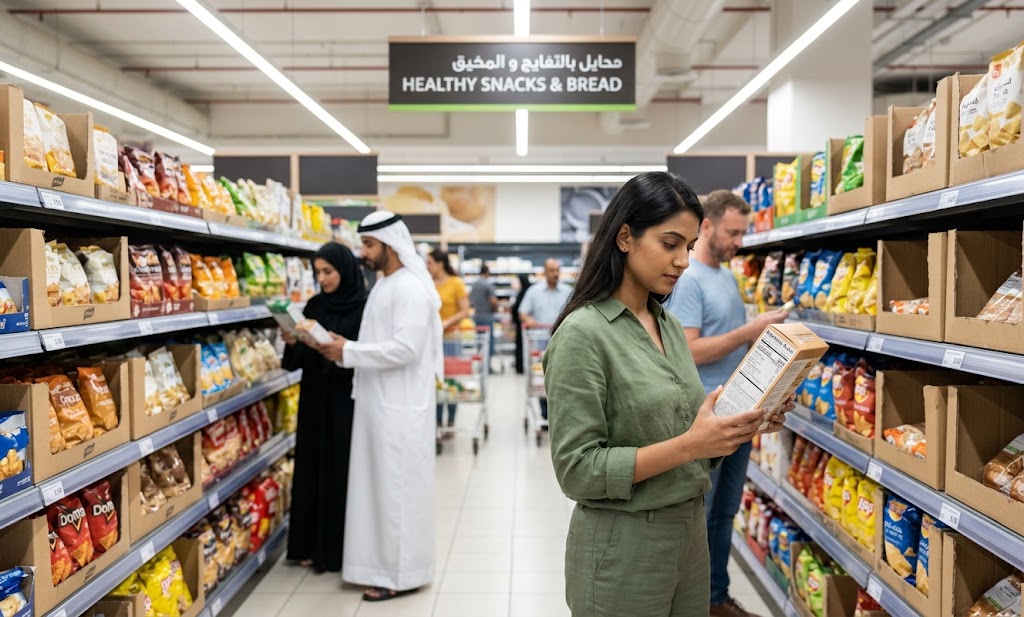
The UAE is introducing new limits on sodium, sugar and fat in selected packaged foods, as part of a national push to improve nutrition and encourage healthier food choices. The new framework gradually reduces the permitted levels of targeted ingredients in several commonly consumed products, including bread, sweetened milk drinks, flavoured yoghurt and laban, salty snacks and processed cheese.
The rules are aimed at improving the nutritional quality of food products and supporting efforts to reduce obesity and other non-communicable diseases. The UAE’s national healthy-lifestyle policy has also identified reducing salt, sugar and unhealthy fats in processed foods as a key public-health objective. For businesses, the changes come with a phased implementation period and serious penalties for non-compliance, including fines of up to AED 500,000.
Who Has To Follow The New Rules?
The requirements cover businesses involved across the food supply chain. That includes activities such as:
- Production and manufacturing
- Food preparation and processing
- Packaging
- Import and export
- Transportation and storage
- Distribution
- Serving and display
- Sale of specified packaged foods
The rules apply to qualifying products manufactured in the UAE or imported into the country, including products handled by businesses operating in free zones.
However, products manufactured or imported specifically for direct export or onward export outside the UAE are exempt, provided they are not subsequently sold within the country.
Read More: UAE: 10 Pinktober Dining Deals Supporting Breast Cancer Awareness This October
Which Foods Are Affected?
The new limits focus on selected everyday packaged foods and are being introduced in two groups.
Group One
The first group covers:
- Leavened bread
- Flat bread
- Sweetened milk drinks and milk alternatives
- Sweetened or flavoured yoghurt
- Laban
- Selected salty snacks
Group Two
The second group focuses on:
- Processed cheese
Rather than introducing the final limits immediately, the UAE is giving businesses time to reformulate products and progressively reduce the targeted ingredients.
New Sodium, Sugar And Fat Limits For Bread
Bread is among the major food categories affected by the new requirements.
The limits are measured per 100 grams and become stricter in the final phase.
| Product | First Phase | Final Phase |
| Leavened bread – Sodium | 444 mg | 370 mg |
| Leavened bread – Total sugar | 6 g | 5 g |
| Leavened bread – Total fat | 8.4 g | 7 g |
| Flat bread – Sodium | 384 mg | 320 mg |
| Flat bread – Total sugar | 6 g | 5 g |
| Flat bread – Total fat | 8.4 g | 7 g |
This means manufacturers will need to gradually reformulate qualifying bread products to reach the final limits by the end of the implementation period.
Sugar Limits For Milk Drinks, Yoghurt And Laban
Sweetened dairy products and milk alternatives will also face tighter sugar limits. For sweetened milk drinks, including milk alternatives, the total sugar limit moves from 9.6g in the first phase to 8g in the final phase per 100g. For sweetened or flavoured yoghurt and laban, the limit decreases from 12g to 10g per 100g.
The staged approach gives manufacturers time to adjust recipes while progressively lowering the amount of added sugar in qualifying products.
Sodium Limits For Salty Snacks
Several popular snack categories are also included in the framework.
The sodium limits will gradually decrease as follows:
| Food Category | First Phase | Final Phase |
| Salted crackers | 696 mg | 580 mg |
| Salted nuts and seeds | 336 mg | 280 mg |
| Pretzels | 912 mg | 760 mg |
| Extruded snacks and chips | 564 mg | 470 mg |
The final limits are intended to reduce sodium levels in these products over time rather than requiring manufacturers to make the full reduction immediately.
Processed Cheese Will Also Have Tighter Sodium Limits
Processed cheese forms the second group covered by the new framework. For spreadable processed cheese, the sodium limit starts at 864mg per 100g before falling to 720mg in the final phase. For other processed cheeses, the limit decreases from 1,200mg to 1,000mg per 100g.
How Long Do Businesses Have To Comply?
The implementation timeline depends on which group a product belongs to.
Group One: Up To Nine Months
Businesses producing bread, sweetened milk drinks, flavoured yoghurt and laban, and specified salty snacks have up to nine months from the resolution’s effective date to meet the first-phase limits.
Group Two: Up To Two Years And Three Months
Businesses dealing with processed cheese have a longer transition period, with up to two years and three months to meet the first-phase requirements. Both groups must continue reducing the targeted ingredients and reach the final limits by December 31, 2030.
What Happens To Products Already Made?
There is also a transition arrangement for products manufactured or imported before the resolution takes effect. These products can continue to be sold for up to one year from the effective date or until their expiry date, whichever comes first. After that period, products that do not meet the applicable limits cannot be traded in the UAE.
Can Businesses Apply For An Exception?
In certain circumstances, businesses can apply for an exception to the first-phase limits. This may apply where complying with the first-phase requirement would require a product to reduce a targeted ingredient by more than 20% of its established level.
Applications must be submitted to the Ministry within 30 days of the resolution taking effect and must include supporting information such as:
- Technical product data
- Registered nutritional information
- Test results from an accredited laboratory
- A commitment to reduce the targeted ingredient by at least 20% during the first-phase period
However, an approved exception does not remove the requirement to reach the final limits. Businesses will still need to comply with the final requirements by December 31, 2030.
What Are The Penalties For Non-Compliance?
Businesses that fail to comply could face penalties ranging from warnings to significant financial fines.
Depending on the violation, authorities may impose fines of between AED 5,000 and AED 500,000.
Additional enforcement measures can include:
- Temporary closure of an establishment for up to six months
- Renewal of the closure where applicable
- Cancellation of a licence or approval
- Coordination with the relevant licensing authority
The measures mean food businesses will need to pay close attention to product formulations, nutritional information and compliance deadlines.
Who Will Monitor The New Requirements?
Implementation and compliance monitoring will involve federal and local health authorities and other relevant bodies, working in coordination with the UAE Ministry of Health and Prevention.
For manufacturers and food businesses, that means the new limits are not simply voluntary nutritional targets. They form part of a regulatory framework that will be progressively enforced.
Read More: Your 10-Point Checklist You Need To Complete Before You Move Out Of The UAE
What Does This Mean For UAE Consumers?
For shoppers, the biggest change is likely to happen gradually rather than overnight. The products covered by the framework will progressively contain lower levels of sodium, sugar and fat as manufacturers reformulate them to meet each stage of the requirements.
The UAE’s wider healthy-lifestyle policy already identifies reducing consumption of foods high in salt and sugar, as well as reducing unhealthy fats in processed foods, as important public-health measures.
For consumers, this could eventually mean that some familiar packaged foods available across UAE supermarkets have different nutritional profiles than they do today. For businesses, meanwhile, the message is clear: the transition period has started, but the final deadline is already set for December 31, 2030.
