

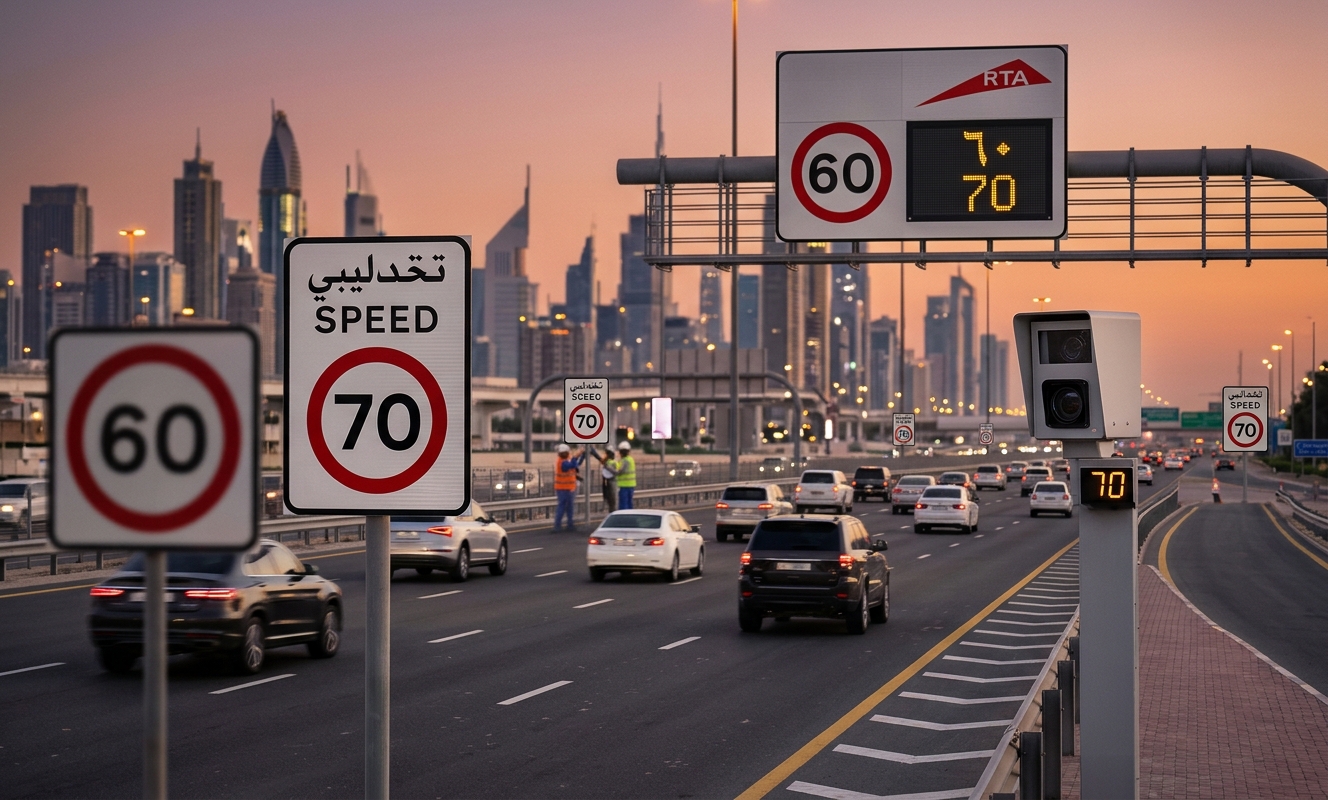
The Roads and Transport Authority announced on Wednesday that speed limits on five major Dubai roads will change from November 1, 2026. Three go up. Two come down. Every change applies in both directions.
Roads Where The Limit Is Going Up
Al Asayel Street gets the biggest jump, rising from 60 to 80 km/h between Oud Maitha Street and Al Meydan Street.
Al Mustaqbal Street moves from 60 to 70 km/h, along the stretch between Sheikh Rashid Street and Al Meydan Street.
Latifa bint Hamdan Street also goes from 60 to 70 km/h, between Sheikh Zayed Road and Al Khail Road.
Roads Where The Limit Is Coming Down
Two roads move the other way. Al Rebat Street drops from 100 to 90 km/h, between Marrakech Street and Sheikh Mohammed bin Zayed Road.
Sheikh Sabah Al Ahmad Al Jaber Al Sabah Street falls from 80 to 70 km/h, between 2nd December Street and Khalid bin Al Waleed Street.
Read More: Where to See the Orionid Meteor Shower in the UAE ?
What Happens On The Ground
Dubai Police were part of the decision. Signs along all five roads will be replaced, and the speed cameras will be reprogrammed so they match the new limits before the changes take effect.
That last detail matters. A camera doesn’t care what you remember the limit to be.
Why These Roads, Why Now
The RTA says the changes come out of an engineering study carried out over recent months with an international consultant. The aim was to improve traffic flow, strengthen road safety and bring limits in line with how each road actually behaves.
The study draws on the 2026 updates to the Dubai Speed Management Manual, which pulls in international best practice on balancing efficiency and safety.
The criteria behind a limit are fairly detailed: traffic volumes, road design speeds, how built-up the surrounding area is, and actual vehicle speeds, measured using the 85th percentile speed. Pedestrian activity and nearby key facilities are weighed in too.
The RTA adds that it reviews limits on major roads regularly, as part of its wider road development work.
Our Take
The mix is the interesting part. Had every limit gone up, you could read it as a simple push for speed. Had every limit gone down, it would look like a crackdown. Neither happened. Raising a limit on one road and cutting it on another suggests the data is doing the talking, particularly the 85th percentile measure, which reflects how drivers behave rather than what a signboard has said for years.
Is that a fair way to set limits? Mostly, yes. Limits that match real conditions tend to be easier to follow. The risk is in the first few weeks, when habit overrides signage. The reduced-limit roads are where drivers are likeliest to get caught out, since muscle memory says 100 or 80 and the camera now says otherwise.
Pro Tip
If one of these roads is on your daily commute, spend the first week of November driving it with your eyes on the signs, not your memory. Don’t rely on cruise control set from habit, and don’t assume your navigation app has updated yet. Apps can lag behind new limits.
The two reduced-limit roads deserve the most attention. A 10 km/h gap sounds small until a camera disagrees with you.
Read More: Sheikh Hamdan Invites 500 Leaders To Shape Dubai’s Future At Dubai Future Week
FAQs
When do the new speed limits take effect in Dubai?
The new limits apply from November 1, 2026, in both directions on all five roads.
Which roads are getting higher speed limits?
Al Asayel Street (60 to 80 km/h), Al Mustaqbal Street (60 to 70 km/h) and Latifa bint Hamdan Street (60 to 70 km/h).
Which roads are getting lower speed limits?
Al Rebat Street drops from 100 to 90 km/h, and Sheikh Sabah Al Ahmad Al Jaber Al Sabah Street drops from 80 to 70 km/h.
Will speed cameras reflect the new limits?
Yes. The RTA says cameras will be reprogrammed and signs replaced along the affected roads ahead of implementation.
How did the RTA decide on the new limits?
Through an engineering study with an international consultant, using the 2026 Dubai Speed Management Manual. Criteria include traffic volumes, road design speeds, urban development, actual vehicle speeds (85th percentile), and pedestrian activity.
