

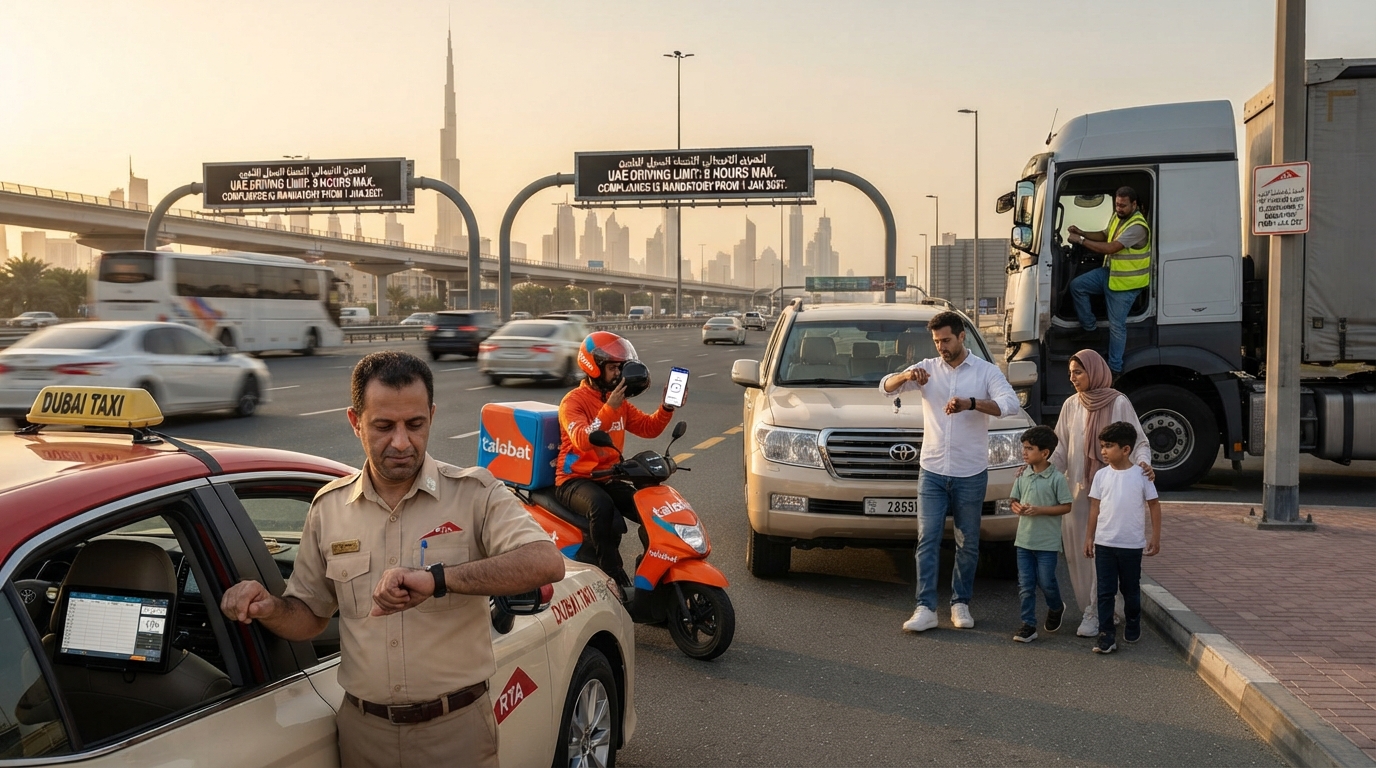
Quick answer: From 1 January 2027, nobody in the UAE may drive for more than nine hours in any 24-hour period. The UAE’s 9-hour driving limit comes from Cabinet Decision No. 174 and covers private motorists as well as people who drive for a living. You must also stop earlier if tiredness affects your control of the car, even if you are under nine hours.
Most headlines about the 9-hour driving limit in the UAE have focused on lorries and buses. That is understandable, but it leaves a lot of people guessing. What about a taxi driver on a long shift, a rider switching between two delivery apps, or a family driving from Abu Dhabi to Ras Al Khaimah and back in a day? This guide breaks the new rule down by job type, so you can see quickly whether your day needs to change.

What the 9-hour driving limit in the UAE actually says
Cabinet Decision No. 174 was issued on 6 October 2026 and published in Official Gazette issue 833 on 14 October. Its provisions apply across all seven emirates from 1 January 2027, as Arabian Business reported.
Two duties sit side by side. The first is the ceiling itself: once you reach nine hours of driving within 24 hours, you must stop. The second is about fatigue. If you are too tired to concentrate or control the vehicle safely, you must stop driving, even if you have only been on the road for two hours. The Federal Traffic Council can also change the permitted duration in future.
The decision is not limited to heavy vehicles. It applies to drivers in general, which is why it matters well beyond the logistics sector.
Who the UAE driving limit affects, job by job
The table below is our reading of how the rule lands for different drivers. It is based on what has been published so far, not on official guidance for each profession.
| Who you are | Covered? | What changes in practice |
|---|---|---|
| Private motorist (commuting, school runs) | Yes | Very little. Most daily driving is well under nine hours. |
| Family on a long road trip | Yes | Plan breaks, share the driving or stay overnight on long multi-emirate days. |
| Taxi driver | Yes | Long shifts may need handovers or rest built in once driving time nears nine hours. |
| Ride-hailing driver using more than one app | Yes | The limit is per driver, so hours on different apps add up. |
| Delivery rider | Likely | Published summaries refer to “drivers” without excluding motorcycles. Assume it applies until told otherwise. |
| Lorry and truck driver | Yes | Biggest impact. Long cross-emirate runs must fit within the ceiling or be split between drivers. |
| Bus driver (school, staff, intercity) | Yes | Operators will need rosters that track total driving time across routes. |
| Chauffeur or private driver | Yes | Waiting time is not driving time, but long days with several trips need tracking. |
| Sales reps and field technicians | Yes | Rarely affected, except on days with long site visits across emirates. |

Why the UAE is introducing the limit now
Fatigue is a real factor on UAE roads. The Ministry of Interior recorded 20 accidents linked to driver fatigue and drowsiness in 2025. In late October, Dubai Police repeated its warning after a truck driver became drowsy on Emirates Road, lost control and hit a safety barrier. Renewed attention also followed two crashes in Fujairah in which 14 people died, according to The National.
The new rule gives the police and employers a clear number to work with, while the fatigue clause keeps the focus on whether a driver is actually fit to be behind the wheel.
Read More: Driving During a Sandstorm in the UAE: Essential Safety Rules Every Motorist Should Know
What fleet operators need to do before January
Logistics companies, passenger transport operators and delivery businesses have the rest of 2026 to adjust. In practice that means three things:
- Track driving time per driver, not per vehicle, using telematics or logbooks.
- Split long routes so a second driver takes over before the nine-hour mark.
- Write a simple fatigue policy that lets drivers stop without fear of losing pay.
What we still don’t know
The reports we have reviewed do not set out the fine or black points for breaking the limit, and they do not explain exactly how driving time will be measured, for example whether time stuck in traffic counts. We will update this guide when the Ministry of Interior or the Federal Traffic Council publishes more detail. Official updates usually appear on the Ministry of Interior website.
Other changes in the same decision cover vehicle roadworthiness, seatbelts for front and rear passengers, where to stop for passengers and loading, and priority at junctions and roundabouts without signals.
Read More: Dubai Announces New Speed Limits on Five Major Roads: Full List Here
Pro Tip
If you drive for work, start a simple log now: start time, finish time and breaks. When the rule begins, you will already know whether your normal day goes over nine hours, and you will have a record if your employer or a police officer ever asks. Keeping a clean record also helps if you are planning to use schemes such as Day Without Accidents to remove black points.
Our Take
For most residents, the nine-hour cap will change nothing. For professional drivers it is a big shift, and the fatigue clause may matter even more than the number. The real test will be whether employers plan rosters around it, or leave drivers to choose between the law and a full day’s pay.
FAQs
When does the 9-hour driving limit start in the UAE?
On 1 January 2027, across all seven emirates.
Does the UAE driving limit apply to private cars?
Yes. Cabinet Decision No. 174 applies to drivers in general, not only to heavy vehicles.
Can I keep driving if I am under nine hours but feel tired?
No. You must stop if fatigue affects your concentration or control, whatever your total driving time.
What is the fine for breaking the nine-hour limit?
No fine has been published yet in the reports we reviewed. We will update this page when it is announced.
