

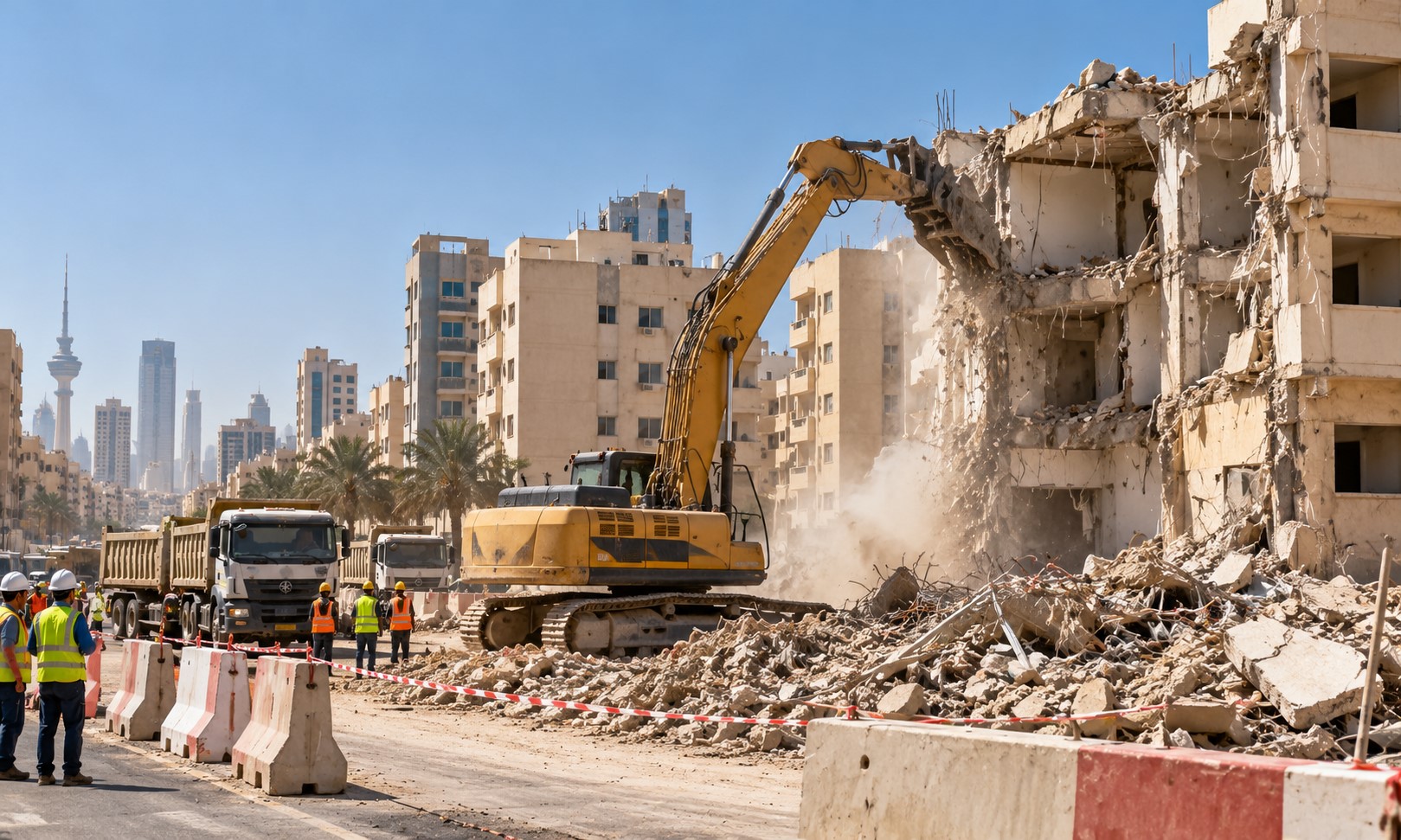
Kuwait Municipality has begun demolishing 263 properties in Jleeb Al-Shuyoukh after their owners failed to act on removal orders, Arab Times reported on 26 October 2026. A second batch of 494 properties is expected to follow in about three weeks.
The Times Kuwait carried the same figures a day later. Both reports rely on unnamed municipal sources, and no official has been named on the record.
Who is Affected
Jleeb Al-Shuyoukh lies close to Kuwait International Airport in Farwaniya Governorate. It is home to large numbers of expatriate workers and has some of the oldest and most densely occupied housing in the country.
Tenants are therefore watching the campaign as closely as landlords. None of the reports gave a figure for how many people live in the affected buildings.
Why these buildings were chosen
The 263 figure appears to match an earlier Ministry of Public Works survey. The Times Kuwait reported on 4 October that the ministry’s report covered 286 properties in the area, of which 263 were judged to be at risk of collapse.
The remaining 23 were four new buildings, one under restoration, 16 empty plots and two buildings still under construction.
A technical inspection concluded that the dilapidated buildings endangered residents, passers-by and neighbouring properties. According to the same report, the inspections followed a security campaign in Jleeb that uncovered illegal housing.
Read More: Kuwait Links Bank Records To Labour Files To Check Expat Pay
The warning period
The municipality gave owners two weeks to begin demolition themselves, counted from the date their property details were published in Kuwait Alyawm, the official gazette. A municipal source said some owners were hard to trace, which slowed notification.
Arab Times said that because owners did not comply voluntarily, the municipality was now entitled to step in under the law.
Three phases, and owners pay
According to municipal sources quoted by Arab Times, the campaign has three stages.
- Phase one: the 263 properties now being cleared.
- Phase two: 494 properties, due to start in roughly three weeks once the municipality’s Director General signs off.
- Phase three: not yet scheduled. The municipality is waiting for technical reports and property lists from the Ministry of Public Works.
Owners will be charged the full cost of demolition and rubble removal. The bill for each building will be worked out case by case, taking into account the truck route, the equipment needed, the number of floors and the total built area. No figures have been published.
What residents should do
The first step for tenants is to find out whether their building is on one of the lists. Owners were notified through the official gazette, so a landlord who has received an order should know. Tenants in older blocks who have heard nothing may want to ask their landlord or building watchman directly rather than wait.
Anyone who has to move should keep copies of their tenancy contract and rent receipts. These will matter in any dispute over deposits or advance rent.
People who change homes in Kuwait are generally expected to update their address with the Public Authority for Civil Information (PACI), since the civil ID address is used across government services. Check the current procedure with PACI.
Workers whose housing is arranged by an employer should raise the matter with the company early. With almost 500 more properties approaching, demand for rooms in nearby areas could rise quickly.
What comes next
The next milestone is the Director General’s decision on the 494 properties in the second batch. After that, the Ministry of Public Works reports will decide how many buildings are added in phase three. The municipality says it will apply the rules firmly.
Read More: Oman Confirms National Day Holiday On 25 and 26 November
FAQ’s
How many buildings is Kuwait Municipality demolishing in Jleeb Al-Shuyoukh?
The first phase covers 263 properties, according to Arab Times on 26 October 2026. A second phase of 494 properties is expected in about three weeks, subject to the Director General’s approval.
Why are the Jleeb Al-Shuyoukh buildings being demolished?
A Ministry of Public Works survey, reported by The Times Kuwait, found the 263 buildings at risk of collapse. Owners did not act on removal orders published in the official gazette, so the municipality stepped in.
Who pays for the demolition?
Owners will be charged the full cost of demolition and rubble removal, according to municipal sources quoted by Arab Times. The cost will be calculated per building, and no figures have been published.
How can tenants check if their building is affected?
Ask the landlord or building watchman, as owners were notified through the official gazette, Kuwait Alyawm. Tenants should also keep their tenancy contract and rent receipts in case they need to move.
